

Empire of the Sun artwork
Even though you might not have lived through a particular decade, such as the 1920s, you’ll still be able to recognize if something references the era by picking up on visual clues https://voltage-bet.io/. We’ll explore this side of vintage design in more detail below.
Often inspired by 1950s graphic design, mid-century illustration, and vintage 70s graphic design, retrofuturism exaggerates the true historical form of objects often related to space travel, abstracting them to create a more cartoonish appearance.
1 Fabulous Monkey This antique natural history print, features such a gorgeous looking monkey! This cute monkey is climbing on a branch. He is in dark brown, with what looks like grey stripes on his face, and deep brown eyes. Be sure and click to view details on this amazing print, it’s amazing how the individual hairs of his fur are drawn in.
The Bauhaus’s favored palette of white, red, blue, yellow, and black instantly conjures up the impression of an early Modernist style. Use the colors in combination to transport your designs to Pre-War Europe.
Letterpress is one of the oldest printing techniques, using a method of relief printing to create an engraved color effect. The effect adds an appealing hand-done look to designs, which makes it a great pairing for vintage-style layouts.
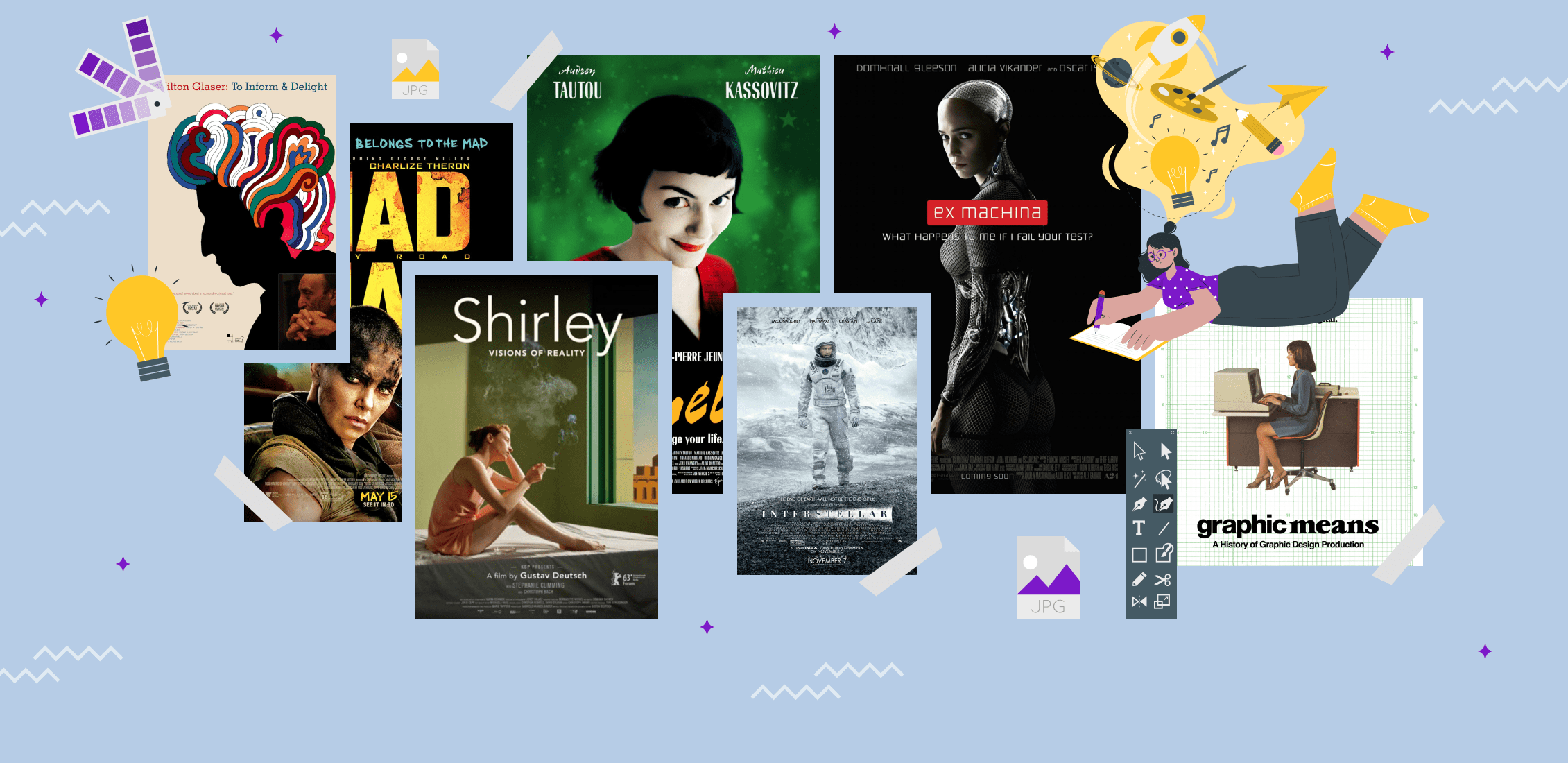
Film graphic
I recommend taking a look at my dailies and personal projects page, which will give you a good starting point for coming up with your own projects (as well as frank insight into my own early design work, which I have had described as “bold” and “not quite Air Bud 6 material, I’m afraid”). For further inspiration, I also wrote some tips on finding design inspiration, because I don’t know how to communicate to people outside of tips anymore. 1) thank you for reading. 2) goodbye.
A scripted graphic refers to any graphic element written in the script. The script is the primary guide for all props and scenery intended for character action, film design, tone, and era. Read the dialogue and scene descriptions for details about a graphic, including exact wording for any text, specific names, photos, illustrations, and screen graphics. This might include folding up a note, scrolling through a webpage, or spray painting graffiti on a wall. Also, a graphic might have exact wording in an actor’s dialogue, like a letter; in that case, the graphic needs to say exactly what the actor is speaking.
I recommend taking a look at my dailies and personal projects page, which will give you a good starting point for coming up with your own projects (as well as frank insight into my own early design work, which I have had described as “bold” and “not quite Air Bud 6 material, I’m afraid”). For further inspiration, I also wrote some tips on finding design inspiration, because I don’t know how to communicate to people outside of tips anymore. 1) thank you for reading. 2) goodbye.
A scripted graphic refers to any graphic element written in the script. The script is the primary guide for all props and scenery intended for character action, film design, tone, and era. Read the dialogue and scene descriptions for details about a graphic, including exact wording for any text, specific names, photos, illustrations, and screen graphics. This might include folding up a note, scrolling through a webpage, or spray painting graffiti on a wall. Also, a graphic might have exact wording in an actor’s dialogue, like a letter; in that case, the graphic needs to say exactly what the actor is speaking.
Our mission is to create tactical, actionable articles that teach valuable skills. We want to highlight the amazing work that’s being done every day in our industry, but instead of conducting armchair interviews, we dive into the messy details and show you how it actually works.
Look around yourself right now. Odds are that in your immediate vicinity there are everyday objects that you only notice when you need them, when they are explicitly singled out, or when you’re bored and your eyes begin to wander. Leafed-through newspapers, stacks of magazines, shelf-worn books, posters, letters, fabrics, signs, postcards, clothing and box labels, wallpaper, and candy wrappers are all examples of objects that exist in our world whether we actively acknowledge them or not.
Classic artwork
Critics argue whether the “primitive” style reflects “accidental profundity” or satirical intent. Its flatness accentuates emotional resonance as with his other jungle scenes. Rousseau claimed it as his favorite work. Pablo Picasso later threw a banquet in Rousseau’s honor, cementing avant-garde admiration. Through its enigmatic spell and confrontation with uncertainty, The Sleeping Gypsy still echoes Rousseau’s creative maxim – “we cannot begrudge our share of the unknown”.
Some consider Pablo Picasso’s masterwork of the Spanish Civil Battle to be the single finest war artwork of all history. Picasso’s artwork, in addition to being a huge allegorical picture of the horrors of war, may have purposely molded spectators into proactive participants, promoting both collective change and policy choices.
A peasant in white attire with yellow sombrero struggles on all fours with a ridiculously enormous basket of flowers attached to his shoulders with a yellow strap in the vibrant artwork. A lady, most likely the farmer’s spouse, stands behind him, attempting to assist with the basket’s support as he strives to climb to his feet.

Critics argue whether the “primitive” style reflects “accidental profundity” or satirical intent. Its flatness accentuates emotional resonance as with his other jungle scenes. Rousseau claimed it as his favorite work. Pablo Picasso later threw a banquet in Rousseau’s honor, cementing avant-garde admiration. Through its enigmatic spell and confrontation with uncertainty, The Sleeping Gypsy still echoes Rousseau’s creative maxim – “we cannot begrudge our share of the unknown”.
Some consider Pablo Picasso’s masterwork of the Spanish Civil Battle to be the single finest war artwork of all history. Picasso’s artwork, in addition to being a huge allegorical picture of the horrors of war, may have purposely molded spectators into proactive participants, promoting both collective change and policy choices.
A peasant in white attire with yellow sombrero struggles on all fours with a ridiculously enormous basket of flowers attached to his shoulders with a yellow strap in the vibrant artwork. A lady, most likely the farmer’s spouse, stands behind him, attempting to assist with the basket’s support as he strives to climb to his feet.